Best time to visit Masai Mara: herds, rain and fees by month
The best time to visit Masai Mara, Kenya, for the wildebeest herds is August or September: large herds were recorded in the Mara in August in 26 of 26 seasons and in September in 25 of 25 seasons. July follows with 19 of 24 seasons and is the driest month at Keekorok. The park fee per non-resident adult is USD 200 a day from 1 July to 31 December and USD 100 from 1 January to 30 June. June is the low-fee month with the best herd record; April is the wettest.
Some links on this page are affiliate links: the guide earns a commission when you book through them. The partner sets the price; the guide adds no fee.
Saa·The month board
Twelve months: herds, rain and the fee
Each column is a month. The red bar shows in how many recorded seasons large herds were in the Mara that month, from the Mara Conservancy's monthly reports for 2001 to 2026. The blue bar shows the rain at Keekorok in 8 of 10 years, with the black tick at the mean. Sort the months by what matters most to you, or pick one for its card.
Sort
Pick a month for its card.
MonthHerds large herds recorded in the Mara, seasons on recordRain Keekorok, range in 8 of 10 years, mean rain daysFee per non-resident adult per day
January Low season
Herds
2 of 25 seasons
had large herds still in the Mara in January; they left during the month (the 2003 and 2005 seasons). In the others they had gone before January.
Rain at Keekorok
25 to 120 mm
in 8 of 10 years; mean 75 mm, with rain on 7 days in an average January.
Days about 28 °C (82 °F), nights about 15 °C (59 °F).
Park fee
USD 100
per non-resident adult per day, 1 January to 30 June; a child 9 to 17 pays USD 50. A ticket is valid 6:00 to 18:00 on the day.
Park fees for three days: USD 200 to 300 (2 or 3 ticket days). Lowest listed three-day safari with these fees added: USD 385.
First large herds of the season recorded in August: 5 of 24 seasons.
First Mara River crossing of the season in August: 5 of 25 seasons.
Recorded in every season the reports cover.
In 2025 the herds stayed on the Narok side only about a month; in the Mara Triangle they stayed at least three months (Mara Conservancy, January 2026).
Rain at Keekorok
35 to 95 mm
in 8 of 10 years; mean 60 mm, with rain on 4 days in an average August.
Days about 28 °C (82 °F), nights about 14 °C (57 °F).
Park fee
USD 200
per non-resident adult per day, 1 July to 31 December; a child 9 to 17 pays USD 50. A ticket is valid 6:00 to 18:00 on the day.
Park fees for three days: USD 400 to 600 (2 or 3 ticket days). Lowest listed three-day safari with these fees added: USD 385.
Herds, rain and the park fee by monthHerds: Mara Conservancy reports, seasons on record. Rain: Keekorok, 1991 to 2020. Fee: non-resident adult, per person per day.
Month
Large herds in the Mara
Rain, 8 of 10 years
Rain days
Park fee
January
2 of 25 seasons, leaving that month
25 to 120 mm
7 days
USD 100
February
none; gone before February in 25 of 25 seasons
40 to 115 mm
7 days
USD 100
March
none; gone before March in 25 of 25 seasons
70 to 180 mm
10 days
USD 100
April
none; first recorded in April in 0 of 24 seasons
85 to 290 mm
10 days
USD 100
May
none; first recorded in May in 0 of 24 seasons
45 to 120 mm
6 days
USD 100
June
6 of 24 seasons
35 to 105 mm
5 days
USD 100
July
19 of 24 seasons
20 to 55 mm
3 days
USD 200
August
26 of 26 seasons
35 to 95 mm
4 days
USD 200
September
25 of 25 seasons
20 to 70 mm
4 days
USD 200
October
20 of 26 seasons
20 to 70 mm
6 days
USD 200
November
13 of 25 seasons
55 to 140 mm
8 days
USD 200
December
4 of 24 seasons
45 to 210 mm
7 days
USD 200
A three-day trip in August
Park fees for three days in August: USD 400 to 600, on top of a tour price that leaves them out.
Three-day guided safari from Nairobi on Viator: from USD 195 per person for two adults, listed 12 November 2026; the price varies by group size and park fees are excluded.
More trips for your budget, days and month, with the fees added: the safari finder.
Mpango·Pick by what you want
Which month fits what you want
26 of 26 seasons
For the herds: August or September
Large herds were in the Mara in August in every season on record and in September in 25 of 25 seasons. These are also the most expensive months: the high-season fee applies. Before you book August, read the current advisory: the US Department of State rates Kenya Level 3, Reconsider Travel (advisory published 18 October 2026), and Is Masai Mara safe? sets out what it covers.
6 of 24 seasons
For the low fee and a chance of herds: June
The last month at USD 100. Large herds were in the Mara in June in more seasons than in any other low-fee month.
35 mm
For dry tracks: July
The lowest mean rain of the year at Keekorok, on 3 days of rain in an average July. Large herds in 19 of 24 seasons.
USD 100
For the lowest fee: January and February
Per adult per day, half the July rate. Rain is moderate (a mean of 70 mm in February). Large herds were rarely in the Mara: in January in 2 of 25 seasons, in February in none.
160 mm
The wettest: April
Mean rain at Keekorok, with 85 to 290 mm in 8 of 10 years. No large herds recorded. The long rains run on into May.
13 of 25 seasons
Herds leaving: November
Seasons on record with large herds still in the Mara in November. The short rains begin, and the fee stays at the high-season rate until 31 December.
Mto Mara·The herds and the river
How often the herds were in the Mara
The record comes from the Mara Conservancy, which manages the Mara Triangle and has published a report most months since 2001. A month counts when a report records large herds in the Mara at any point in it, on either side of the river. Over 26 seasons the count reads:
26 of 26 seasonsAugust
25 of 25 seasonsSeptember
20 of 26 seasonsOctober
19 of 24 seasonsJuly
Some months are missing from some seasons' reports, so the totals differ. July's count is out of fewer seasons than October's, which is why the board, sorted by most herds, puts July before October.
When the first herds came
The first large herds of a season were recorded in June in 6 of 24 seasons, in July in 13 of 24 seasons and in August in 5 of 24 seasons. The earliest was early June 2014, the latest late August 2015. A study of the same reports for 2001 to 2015 (Subalusky and others, 2017) gives a mean stay in the Mara River region of 172 ± 45 days.
River crossings
The first crossing of the Mara River inside the Mara fell in July in 15 of 25 seasons, in June in 4 of 25 seasons and in August in 5 of 25 seasons. The same study counts crossings on 52 ± 16 days a year in the Kenyan part of the river (2001 to 2015). The Mara Conservancy calls crossings frequent but hard to predict; herds massing nervously on the bank give a good chance of one. No day or week can be booked for a crossing.
When they left
The large herds left in November in 11 of 25 seasons and in October in 5 of 25 seasons. In 2017, 2022 and 2023 they had gone before October; in the 2003 and 2005 seasons they stayed into January. Where the herds spend the rest of the year, in the Serengeti in Tanzania, is on Masai Mara vs Serengeti.
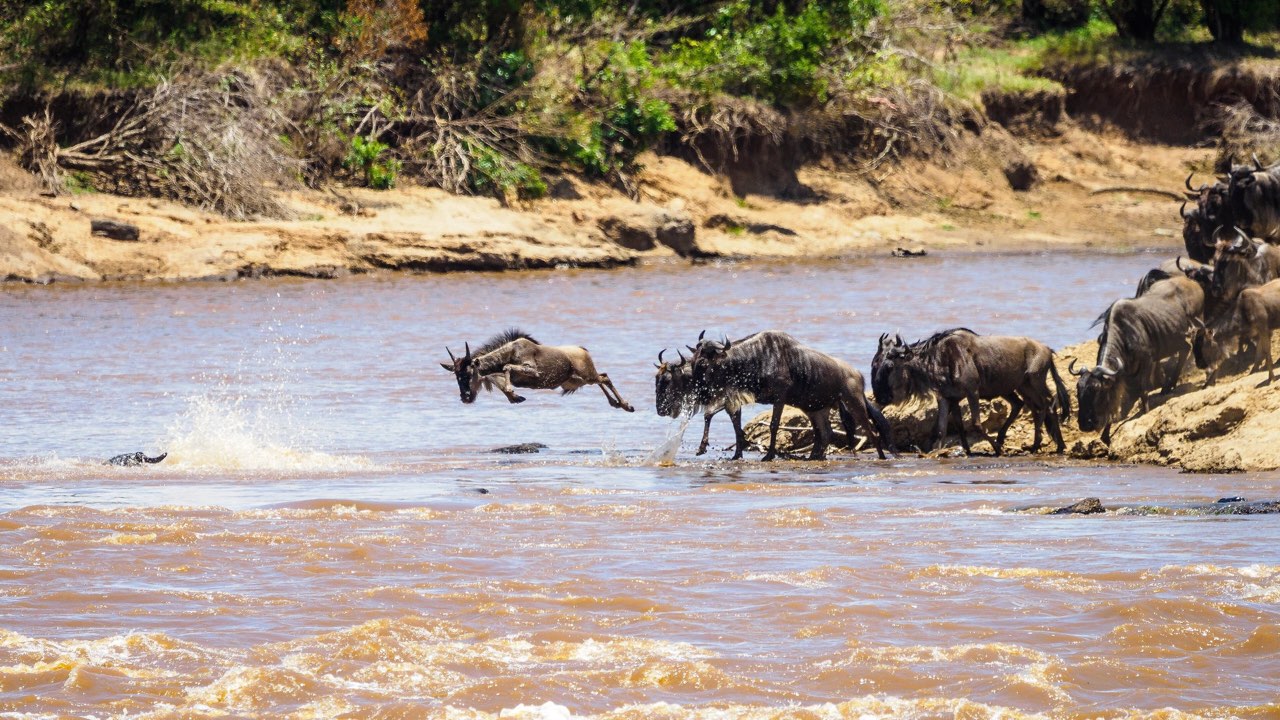
Wildebeest on open grassland in the Masai Mara, Kenya, July 2017.Photo: flightlog / Wikimedia Commons, CC BY 2.0
Shorter stays lately
The Mara Conservancy wrote in November 2022 that the population is stable at about 1,300,000 wildebeest, but the numbers visiting the Mara had halved in ten years and they spend 35 days a year less there.
In 2025 the herds stayed on the Narok side only about a month, with about 14 days of crossings, against 29 in 2024 and 50 in the past. In the Mara Triangle they came in good numbers and stayed at least three months.
In 2021 the herds hardly stayed two months in Kenya, against four in the past, and most crossings that year took place in Tanzania, which has at least 14 recognized crossing points in the Mara Conservancy's September 2021 report, 12 in April 2024. In May 2024 the Mara Conservancy reported no crossings at the main crossing above Serena for 4 years.
Rain moves them too: in 2018 so much rain fell from March to June that, in the report writer's view, the herds had no need to come as far as the Mara.
Rain: the long rains, the short rains and the dry months
The rain figures on this page are for Keekorok, inside the reserve, from the CHIRPS satellite and gauge record for 1991 to 2020: a mean of 955 mm a year. Kenya's 2010 UNESCO entry gives the spread across the Masai Mara as about 800 mm a year in the drier east to about 1,200 mm in the wetter west. In the same CHIRPS record the Mara Triangle point has a mean of 1,055 mm a year.
A study of Mara cheetahs (Broekhuis and Gopalaswamy, 2016) describes two wet seasons and one dry one: short rains in November and December, long rains from March to June, and dry weather from July to October. Kenya's 2023 UNESCO entry puts the long rains at about six to eight weeks in April and May and the short rains at about four weeks in November and December.
The months in rain
April is the wettest month: a mean of 160 mm, 85 to 290 mm in 8 of 10 years. March follows with a mean of 125 mm.
July is the driest: a mean of 35 mm, and in 8 of 10 years 20 to 55 mm. September and October each have a mean of 45 mm.
August is wetter than July, with a mean of 60 mm, though rain falls on only 4 days in an average August.
December swings most from year to year: 45 to 210 mm in 8 of 10 years.
A rain day here is a day with at least a millimeter. Mornings are coolest in July, at about 13 °C (55 °F) on average at Keekorok; the warmest afternoons come in February and October, at about 30 °C (86 °F). What to pack for both is on what to wear on safari in Kenya, and every point's figures are on Masai Mara weather.
A lone acacia at dawn during the long rains, Masai Mara, Kenya.Photo: Kandukuru Nagarjun / Wikimedia Commons, CC BY 2.0
Bei·Fees by month
Half the park fee from January to June
USD 100January to June
USD 200July to December
J
F
M
A
M
J
J
A
S
O
N
D
Park fee for the Maasai Mara National Reserve and the Mara Triangle, per person per day.
Who
1 January to 30 June
1 July to 31 December
Non-resident adult
USD 100
USD 200
Non-resident child 9 to 17
USD 50
USD 50
The Narok County Finance Act 2023 sets the high season from 1 July to 31 December and the low season from 1 January to 30 June. The rate card of the Mara Conservancy and Narok County charges the same fee whether you sleep inside or outside the reserve. A ticket is valid from 6:00 to 18:00 on the day, whatever time you enter, and a game drive on the day you leave needs a new one. Narok County says the seasonal rates are meant to spread visitors across the year.
USD 200 to 300Park fees for three days in February
USD 400 to 600Park fees for three days in August
Per adult, for 2 or 3 ticket days, depending on a drive on the last day.
Safarilink's published fare is the same all year: its return fare from Nairobi Wilson to the Masai Mara is USD 425 per adult in both seasons of 2026, before taxes. Its booking engine, read 12 November 2026, offered USD 298 each way with tax for both a January and an August date. AirKenya's read fare was higher for August: USD 221 one way for 11 January 2027 against USD 308 for 12 August 2027 (flights to the Masai Mara). What a whole trip costs is on Masai Mara safari cost; how the ticket works on Masai Mara entrance fee.
A male leopard resting in an acacia tree in the Maasai Mara National Reserve, Kenya, February 2020.Photo: Sumeet Moghe / Wikimedia Commons, CC BY-SA 4.0A lioness in the Masai Mara, Kenya, June 2018.Photo: Kandukuru Nagarjun / Wikimedia Commons, CC BY 2.0
June is the last month at the low fee. Large herds were in the Mara in June in 6 of 24 seasons, more than in any other month at that rate.
Watu·People at the river
Crowds at the river crossings
Zebra and wildebeest grazing together in the Masai Mara, Kenya, December 2018.Photo: Michelle Juma / Wikimedia Commons, CC BY-SA 4.0
Crossings draw vehicles. On one day in August 2019 the Mara Conservancy counted 180 vehicles at a crossing, the most it had recorded. The reserve's management plan for 2023 to 2032 records more than 150 vehicles at a single crossing and proposes that Narok County study a separate, capped ticket for crossings.
The same plan sets the reserve's best capacity at about the density the Mara Triangle already reaches in high season, and gives higher high-season densities for the central Mara on the Narok side.
Rooms fill too. A Booking.com search read on 12 November 2026, two adults for two nights, offered 131 properties for 14 to 16 February 2027 and 108 properties for 10 to 12 August 2027. Where to base yourself is on where to stay in the Masai Mara; balloon flights over the reserve are on Masai Mara hot air balloon.
Maswali·Questions
Questions about when to go
When should you avoid the Masai Mara?
If you want the herds, avoid February to May: no large herds were recorded in the Mara in those months. April is also the wettest month at Keekorok, with a mean of 160 mm. If you want the low fee, those months cost half the July rate, USD 100 per adult per day.
Which month is best for a Masai Mara safari?
For the herds, August or September: large herds were recorded in August in 26 of 26 seasons and in September in 25 of 25 seasons. July is the driest month. For the low fee with a chance of herds, June, when they were recorded in 6 of 24 seasons. The board above compares all twelve months.
How much does a Masai Mara trip cost in each season?
The park fee per non-resident adult is USD 100 a day from January to June and USD 200 from July to December, so three days of fees come to USD 200 to 300 in February and USD 400 to 600 in August. Safarilink's published return fare from Nairobi is USD 425 in both seasons, before taxes; its booking engine offered USD 298 each way with tax. More on Masai Mara safari cost.
Is August a good time to visit the Masai Mara?
For the herds, yes: large herds were in the Mara in August in 26 of 26 seasons. It is wetter than July, with a mean of 60 mm at Keekorok, and the high-season fee applies, USD 200 per non-resident adult per day. Crossings draw crowds: on one August day in 2019 the Mara Conservancy counted 180 vehicles at one crossing. Read the current advisory on Is Masai Mara safe? before you book.
Can you plan a trip around a river crossing?
Not to the day. The first crossing of a season fell in July in 15 of 25 seasons, and the Mara Conservancy calls crossings frequent but hard to predict. Recent seasons were shorter: in 2025 the Narok side had about 14 days of crossings. The more days you spend near the river in the months with the most herds, the more chances you have.
Sources
Safarilink's booking engine, read on 12 Nov 2026, offered a one-way adult fare of USD 298 (rack fare USD 268 plus USD 30 tax, fare 'PLUS') from Nairobi Wilson to Mara Keekorok airstrip on 11 January 2027, on flights 005 (7:15-8:15, non-stop), 001 (10:00-11:00 via Naivasha Loldia) and 003 (14:15-15:15). Safarilink Aviation: online booking engine, flight results WIL-KEU 2027-01-11, 2026-11-12.
AirKenya's booking engine, read on 12 Nov 2026, offered one-way adult fares from Nairobi Wilson to Mara Keekorok on 11 January 2027 of USD 221 in class 'SPECIAL' (rack USD 171 plus USD 50 tax) and USD 308 in 'Y STANDARD' (rack USD 258 plus USD 50 tax) on flight 851 (7:30-8:10); flight 853 (10:30-11:10) from USD 308. AirKenya: online booking engine, flight results WIL-KEU 2027-01-11, 2026-11-12.
AirKenya's booking engine, read on 12 Nov 2026, offered only 'Y STANDARD' at USD 308 one way (rack USD 258 plus USD 50 tax) between Nairobi Wilson and Mara Keekorok on 12 August 2027 in both directions (flights 851, 853, 951 out; 852, 854, 952 back); no SPECIAL fare was shown. AirKenya: online booking engine, flight results WIL-KEU and KEU-WIL 2027-08-12, 2026-11-12.
Booking.com search for 'Masai Mara / Maasai Mara' (resolves to Maasai Mara National Reserve), 2 adults, 1 room, 2 nights, USD display, read 12 November 2026: 131 properties for 14 to 16 February 2027 and 108 properties for 10 to 12 August 2027. Booking.com: search Masai Mara / Maasai Mara, 2026-11-12.
GetYourGuide listing '3-Day Maasai Mara Group Safari by 4WD' (operator EXCELLENT GAMESPOTTING ADVENTURES), read 12 November 2026: listed price from USD 250 per person, 3 days and 2 nights, group, park fees excluded. GetYourGuide: 3-Day Maasai Mara Group Safari by 4WD, 2026-11-12.
Viator listing '3 Days Maasai Mara Guided Safari from Nairobi' (operator not shown on the page), read 12 November 2026: listed 'from' price USD 195 per person on the search page for 2 adults with no date picked (the page says the price varies by group size), 3 days and 2 nights, group (not stated), park fees excluded ('Government Fees' under exclusions; a separate option includes them). Viator: 3 Days Maasai Mara Guided Safari from Nairobi, 2026-11-12.
The Mara Conservancy states (Nov 2022) that although the wildebeest population remains stable at around 1.3 million, the numbers visiting the Mara have halved in ten years and they spend 35 days a year less there. Mara Conservancy: monthly report November 2022.
Mara Conservancy (January 2026 report, reviewing 2025): the migration stayed in the Main Reserve (Narok side) only about a month in 2025, with about 14 days of crossings, down from 29 in 2024 and 50 days in the past; in the Triangle the wildebeest came in good numbers and stayed at least three months. Mara Conservancy: monthly report January 2026, 2026-02-02.
Mara Conservancy (August 2018 report, the writer's own view): the migration is very population and weather dependent; in 2018 so much rain fell between March and June that the wildebeest had no need to move as far as the Mara, and they only move as far as Kenya if they have exhausted water and forage in the Serengeti. Mara Conservancy: monthly report August 2018.
Mara Conservancy migration FAQ: crossings happen frequently during the migration but are difficult to predict; a massing of agitated wildebeest along the river means a good chance of a crossing. Mara Conservancy: Wildebeest Migration page FAQ.
Mara Conservancy (Sept 2021): most 2021 crossings took place in Tanzania, which has at least 14 recognized crossing points and stricter controls. Mara Conservancy: monthly report September 2021.
Mara Conservancy (April 2024): Tanzania does not allow camps and lodges along rivers and has 12 recognized crossing points; the Conservancy expects the migration to keep crossing in Tanzania and enter the Triangle via the Lemai Wedge. Mara Conservancy: monthly report April 2024.
Mara Conservancy (May 2024 report): there have been no wildebeest crossings at the main crossing above Serena for four years, and the wildebeest have no places left to cross the Talek River. Mara Conservancy: monthly report May 2024.
Mara Conservancy (August 2019 report): on one day 180 vehicles were sighted at a crossing, the most it had recorded so far; it proposes a vehicle levy and a daily ticket limit. Mara Conservancy: monthly report August 2019, 2019-09-01.
The same co-branded rate card charges a non-resident adult USD 100 per person per day from January to June, whether accommodated inside or outside the park; non-resident children aged 9 to 17 and students in organized groups pay USD 50 per person per day in both blocks. Mara Conservancy / KAPS: Park Fees Itemization rate card (Nature Paas ticket portal).
The reserve management plan 2023-2032 puts the reserve's optimal carrying capacity at about 1 to 1.2 visitors per km2, which it says broadly equals high-season densities in the Mara Triangle; in the Central Mara (Narok) section it gives potential high-season densities of 2 to 2.5 visitors per km2, and its summary says pre-COVID high-season densities there were well in excess of 2, potentially as much as 3, visitors per km2. Narok County: Maasai Mara National Reserve Management Plan 2023-2032 (Final, February 2023).
Narok County says seasonal rates for the Maasai Mara National Reserve are meant to spread visitors across the year and keep visitor numbers within the reserve's carrying capacity, as the reserve has higher visitor densities than other Kenyan protected areas. Narok County / Maasai Mara National Reserve: 2025/26 Park Fees & Charges (PDF), 2025-02-26.
Masai Mara safaris by budget. GetYourGuide, Viator and TourRadar listings of Masai Mara safaris, listed price per person read 12 November 2026; park fees from the Mara Conservancy and Narok County Government rate card