masaimara.info
Menu
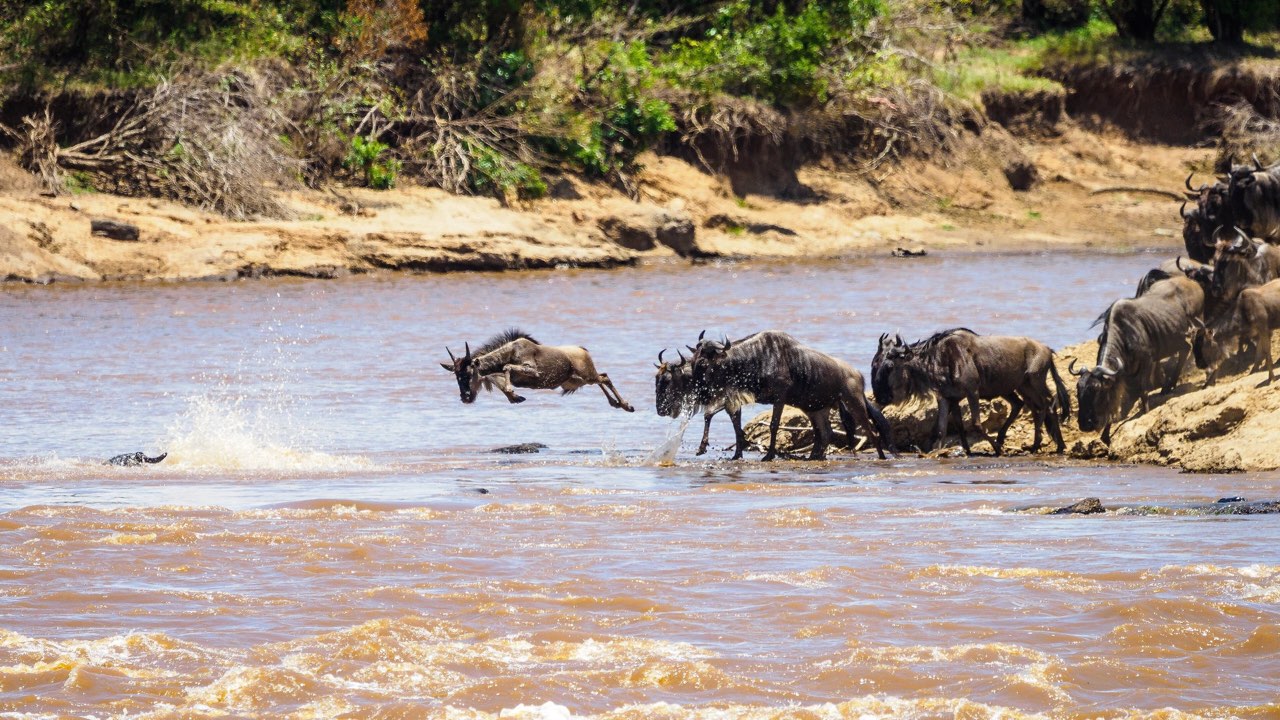
Wildebeest lined up to jump into the Mara River in the Masai Mara National Reserve, Kenya, September 2020.

KaribuKenya and Tanzania, one ecosystem

Masai Mara vs Serengeti: one ecosystem, two countries

Masai Mara vs Serengeti is a choice of country more than of landscape. The Masai Mara, Kenya, and the Serengeti in Tanzania share one ecosystem of 30,000 km² (11,583 sq mi), as Tanzania National Parks states it. A Mara day ticket costs a non-resident adult USD 100 from 1 January to 30 June and USD 200 from 1 July to 31 December, valid 6:00 to 18:00. The Serengeti charges TZS 178,850, valid 24 hours from entry, and guests in Serengeti accommodation add a TZS 153,300 concession fee from 1 July to 30 September 2026.

Photo: Danijel Mihajlovic / Wikimedia Commons, CC BY-SA 4.0

Some links on this page are affiliate links: the guide earns a commission when you book through them. The partner sets the price; the guide adds no fee.

So set three things yourself: the month, the way in and the fee stack. The month decides the rain on both sides and the herds on record in the Mara, where the Mara Conservancy's reports count them season by season over 2001 to 2026. For the Serengeti, the dated record of where the herds stand is one survey, flown by Tanzania's wildlife research institute in March 2023. The way in is Nairobi for the Mara, by road or by a short flight; for the Serengeti it is its own gates and airstrips. The fee stack is two schedules in two currencies, set out below side by side. For the Mara alone, the Masai Mara entrance fee page counts your ticket days.

RamaniWhere Kenya ends

Where the border runs

The Maasai Mara National Reserve sits on Kenya's southern edge. Kenya's 2023 UNESCO tentative-list entry says the reserve is bounded by the Serengeti to the south (UNESCO entry), and it puts the reserve at 1,510 km² (583 sq mi) (Government of Kenya, UNESCO tentative-list entry 2023). Tanzania National Parks gives Serengeti National Park 14,763 km² (5,700 sq mi), established in 1959, and calls it the country's third-largest national park.

The ecosystem the two share has no single size. Tanzania National Parks says 30,000 km²; research papers give 40,000 km² (Veldhuis et al. 2019) and 25,000 km² (Thirgood et al. 2004), because they draw the boundary differently (Veldhuis et al.). The wildebeest do not stop at the line: TAWIRI describes an annual circuit of around 800 km, with most animals covering about 2,500 km in a year as they follow the grass.

People cannot follow them on the ground. The Kenya Revenue Authority lists the Sand River gate on the Mara-Serengeti border as a closed point of entry and exit (points of entry). The whole Kenya-Tanzania border is 755 km long, by the same list. More on the Kenyan side: where the Masai Mara is, the Masai Mara map and who runs the reserve.

The Masai Mara and the Serengeti on either side of the Kenya-Tanzania border The Maasai Mara National Reserve with the Mara Triangle west of the Mara River, the international border along its southern edge, and to the south in Tanzania Serengeti National Park with Klein's Gate, Tabora B Gate and Seronera. KENYA TANZANIA Masai Mara National Reserve Mara Triangle Serengeti National Park international border Keekorok airstrip Klein's Gate Tabora B Gate Seronera To Nairobi 50 km (31 mi) in a straight line
The reserve and the Mara Triangle, the Mara River and the border from OpenStreetMap outlines; Serengeti National Park is marked by its gates and Seronera, not by an outline. Map data © OpenStreetMap contributors.

MvuaRain, herds, fees and flights by month

The two parks, month by month

Pick the month you can travel. The card puts both parks side by side for that month; the table under it holds the whole year. Rain is a 30-year normal for one point in each park, Keekorok in the Mara and Seronera in the Serengeti. For the Mara's own months in full, see the best time to visit the Masai Mara; the herds season by season are on Masai Mara migration.

955 mma year at Keekorok, Narok side

1,055 mma year at Mara Serena, Mara Triangle

830 mma year at Seronera, Serengeti

July in both parks

Masai Mara Kenya

Rain, Keekorok
35 mm in a mean year; 20 to 55 mm in 8 of 10 years
Days with rain
3 days
Day / night
27 °C (81 °F) / 13 °C (55 °F)
Large herds in the Mara
recorded in 19 of 24 seasons
Reserve fee, non-resident adult
USD 200 per person, valid 6:00 to 18:00 on the day

Serengeti Tanzania

Rain, Seronera
10 mm in a mean year; 5 to 15 mm in 8 of 10 years
Days with rain
2 days
Day / night
27 °C (81 °F) / 12 °C (54 °F)
Entrance fee, non-resident adult
TZS 178,850 per person, valid 24 hours from entry
Guests in park accommodation add
TZS 153,300 concession fee, 1 July to 30 September 2026 (the tariff table does not state the unit)

The two fees print in the currency each park charges.

The two parks, January to DecemberRain and temperature 1991 to 2020. Fees per non-resident adult per person: the Mara's valid 6:00 to 18:00 on the day, the Serengeti's 24 hours from entry.
RowJanFebMarAprMayJunJulAugSepOctNovDec
Masai Mara, Kenya
Rain, Keekorok75 mm70 mm125 mm160 mm80 mm65 mm35 mm60 mm45 mm45 mm95 mm105 mm
8 of 10 years25 to 120 mm40 to 115 mm70 to 180 mm85 to 290 mm45 to 120 mm35 to 105 mm20 to 55 mm35 to 95 mm20 to 70 mm20 to 70 mm55 to 140 mm45 to 210 mm
Rain days7 days7 days10 days10 days6 days5 days3 days4 days4 days6 days8 days7 days
Day28 °C (82 °F)30 °C (86 °F)29 °C (84 °F)27 °C (81 °F)25 °C (77 °F)26 °C (79 °F)27 °C (81 °F)28 °C (82 °F)29 °C (84 °F)30 °C (86 °F)28 °C (82 °F)28 °C (82 °F)
Night15 °C (59 °F)15 °C (59 °F)16 °C (61 °F)15 °C (59 °F)15 °C (59 °F)14 °C (57 °F)13 °C (55 °F)14 °C (57 °F)14 °C (57 °F)15 °C (59 °F)15 °C (59 °F)15 °C (59 °F)
Large herds in the Mara left during the month in 2 of 25 seasons gone before the month in 25 of 25 seasons gone before the month in 25 of 25 seasons none recorded (first herds: 0 of 24 seasons) none recorded (first herds: 0 of 24 seasons) recorded in 6 of 24 seasons recorded in 19 of 24 seasons recorded in 26 of 26 seasons recorded in 25 of 25 seasons recorded in 20 of 26 seasons recorded in 13 of 25 seasons recorded in 4 of 24 seasons
Reserve feeUSD 100USD 100USD 100USD 100USD 100USD 100USD 200USD 200USD 200USD 200USD 200USD 200
Serengeti, Tanzania
Rain, Seronera85 mm70 mm120 mm145 mm75 mm30 mm10 mm25 mm35 mm45 mm85 mm100 mm
8 of 10 years45 to 130 mm35 to 110 mm80 to 180 mm70 to 250 mm40 to 120 mm15 to 55 mm5 to 15 mm15 to 40 mm20 to 55 mm20 to 85 mm35 to 145 mm40 to 140 mm
Rain days7 days8 days8 days9 days5 days3 days2 days2 days3 days6 days8 days7 days
Day27 °C (81 °F)28 °C (82 °F)28 °C (82 °F)26 °C (79 °F)26 °C (79 °F)26 °C (79 °F)27 °C (81 °F)28 °C (82 °F)29 °C (84 °F)30 °C (86 °F)28 °C (82 °F)27 °C (81 °F)
Night15 °C (59 °F)15 °C (59 °F)16 °C (61 °F)15 °C (59 °F)14 °C (57 °F)13 °C (55 °F)12 °C (54 °F)13 °C (55 °F)14 °C (57 °F)15 °C (59 °F)16 °C (61 °F)15 °C (59 °F)
Herdsno dated recordno dated recordMost wildebeest on the short-grass plains of the south-eastern Serengeti and the Ngorongoro Conservation Area during TAWIRI's survey, 28 to 31 March 2023no dated recordno dated recordno dated recordno dated recordno dated recordno dated recordno dated recordno dated recordno dated record
Entrance fee TZS 178,850 TZS 178,850 TZS 178,850to 14 Mar no tariff row TZS 178,850from 16 May TZS 178,850 TZS 178,850 TZS 178,850 TZS 178,850 TZS 178,850 TZS 178,850 TZS 178,850
Concession, lodge guestsno tariff rowno tariff rowno tariff rowno tariff rowno tariff rowno tariff rowTZS 153,300TZS 153,300TZS 153,300no tariff rowno tariff rowno tariff row
Between the two
AirKenya, Mara to Seronera daily, min. 2 passengers daily, min. 2 passengers daily, min. 2 passengers not operating from 21 May daily, min. 2 passengers daily, min. 2 passengers daily, min. 2 passengers daily, min. 2 passengers daily, min. 2 passengers min. 4 passengers min. 4 to 15 Dec

Empty cells: no dated figure for that month. The herd counts are seasons on record in the Mara Conservancy's monthly reports, 2001 to 2026; the bar beside each count shows its share.

Rain is in a mean year, from CHIRPS, a satellite and gauge grid, 1991 to 2020 (Climate Hazards Center), so a figure is for the grid cell, not a gauge at a camp. Temperature from NASA POWER reanalysis, a grid cell about 50 km (31 mi) wide; the Mara Triangle point has rain only. Tanzania National Parks gives the Serengeti a rain season from November to April, a dry season from May to October and 900 to 1,000 mm a year (park brochure). Rain on the Kenyan side by month: Masai Mara weather.

Zebra and wildebeest together

Photo: Michelle Juma / Wikimedia Commons, CC BY-SA 4.0

NyumbuThe herds

Zebra and wildebeest graze the same grass on both sides of the line.

NyumbuTwo records, two methods

What each side records about the herds

In the Mara, the record is month by month. The Mara Conservancy's monthly reports cover 26 seasons (2001 to 2026, Mara monthly). The first large herds were recorded from early June (2014) to late August (2015), and the first Mara River crossing from June (2010) to October (2001). Large herds were in the Mara in August in 26 of 26 seasons and in December in 4 of 24 seasons.

A longer view says the same. For 2001 to 2015, Subalusky and colleagues found the herds reached the Mara River region between early June and late July and stayed until November or December, 172 ± 45 days, with crossings in the Kenyan Mara River on 52 ± 16 days a year (Subalusky et al. 2017). Recent seasons have been shorter on the Narok side: the Mara Conservancy counts about 14 days of crossings there in 2025, against 29 in 2024, while in the Triangle the wildebeest stayed at least three months (January 2026 report).

In the Serengeti, the dated record is a count. TAWIRI estimated the migratory wildebeest at 1,366,109 animals (standard error 231,741) from an aerial survey flown 28 to 31 March 2023, when most wildebeest were on the short-grass plains of the south-eastern Serengeti and the Ngorongoro Conservation Area (TAWIRI census 2023). Tanzania National Parks puts the migration at over 1.5 million wildebeest, plus hundreds of thousands of zebras, gazelles and elands.

Where the crossings happen has shifted too. In September 2021 the Mara Conservancy reported that most crossings that year took place in Tanzania, which has at least 14 recognized crossing points (report); in April 2024 it gave 12 recognized crossing points and said Tanzania does not allow camps and lodges along its rivers (report).

How many wildebeest

1,366,109

TAWIRI aerial survey, the whole migratory population, March 2023

fewer than 600,000

Duporge et al. 2025, satellite count over about 4,000 km² of the northern Serengeti and the Mara, August 2022 and August 2023

The satellite authors say differences in coverage may explain part of the gap (paper). A scientist cited by the Mara Conservancy, Dr Grant Hopcraft, challenges the result because the survey covered only about 4,000 km² on both sides of the border (September 2025 report).

Wildebeest herds on the plains
A wildebeest herd on green plains in the Masai Mara, Kenya, November 2011.Photo: Wajahatmr / Wikimedia Commons, CC BY-SA 3.0

PesaWhat one adult pays

The fee ledger for one adult

Each park's fee schedule in its own words and currency. The page does not convert between the two. Lodging, transport and any conservancy fee come on top on both sides; the Masai Mara safari cost page adds up a Kenyan trip line by line.

Kenya, Narok County and the Mara Conservancy

Masai Mara reserve

USD 100 / USD 200

Per non-resident adult per person, 1 January to 30 June / 1 July to 31 December, on the Narok side and in the Mara Triangle (rate card).

  • What a ticket coversValid 6:00 to 18:00 on its day, whatever time you buy it (ticket portal)
  • Child 9 to 17 yearsUSD 50 per person, both seasons
  • Under 9free in the Mara Triangle (Mara Conservancy)
  • BalloonUSD 80 per person per landing, the reserve's landing fee
  • Pay withTriangle: card or M-Pesa only; Narok side: cash in USD or KES, or card
  • Entry to KenyaStandard eTA USD 30 per traveler, fee schedule effective 1 January 2025 (KCAA AIC 14/25)

Tanzania, Tanzania National Parks

Serengeti National Park

TZS 178,850

Per non-resident adult per person, in the season the tariff labels ENTRY HIGH, 16 May 2026 to 14 March 2027 (Serengeti tariff).

  • What a ticket covers24 hours from the time of entry; a longer stay needs additional days paid (tariff page)
  • Child 5 to 15 yearsTZS 51,100 per person, 1 July 2026 to 30 June 2027; under 5 free
  • Guests in park accommodationTZS 153,300 concession fee per non-resident adult, 1 July to 30 September 2026; child 5 to 15 TZS 25,550
  • Balloon, camping, walksBalloon safari fee TZS 127,750; public camping TZS 76,650 per non-resident adult; short walking safari TZS 51,100, long TZS 63,875 (2026/27)
  • Pay withVisa or MasterCard at the gates, mobile money, bank transfer for operators or the online reservation system; fees include 18% VAT where applicable (reservations)
  • Entry to TanzaniaTanzania sets its own visa and health rules; check them with Tanzania's immigration service before you book.

Three differences decide the sums. First, the clock: a Mara ticket ends at 18:00 on its day, so every day you drive in the reserve needs its own ticket, while the Serengeti's fee runs from the moment you enter for a full day and night. Second, the season: the Mara's fee doubles on 1 July, and the Serengeti's concession fee for guests in park accommodation is listed for 1 July to 30 September 2026. Third, the activities: walking safaris have a fee line in the Serengeti, while the Mara reserve and the Triangle ban walks; in Kenya they happen only in the conservancies. A balloon flight carries a park fee on both sides; for the Mara, see hot air balloon.

The Mara's 12-hour ticket and how many days your stay needs are on the entrance fee page, with a calculator.

Bush plane on a Mara airstrip

Photo: Ninara / Wikimedia Commons, CC BY 2.0

MpakaThe connection by air

Between the two parks, the scheduled route goes by air and through a border post.

MpakaGetting in and getting across

Getting in, and getting between them

  • about 5 to 6 hours

    Nairobi to the Mara by road

    By road, without stops, as Mara North Conservancy states it for the drive to its conservancy. The route and the stops: Nairobi to Masai Mara.

  • about 45 minutes

    Nairobi to the Mara by air

    From Wilson Airport, the flight time the airlines state. Safarilink lists USD 260 one way per adult, both seasons 2026, exclusive of taxes (timetable). More: Nairobi to Masai Mara flights.

  • Into the Serengeti

    Tanzania National Parks lists nine road gates, among them Naabi Hill, Ndutu, Ikoma, Tabora B, Lamai and Klein's, and all-weather airstrips at Seronera, Kusini, Lobo, Kirawira, Kogatende and Lamai, with flights from Arusha, Mwanza, Kilimanjaro, Musoma, Dar es Salaam and Zanzibar (park brochure). You enter and leave only at the gates named in your permit.

Safari njemaKenya and Tanzania in one trip

Seeing both on one trip

Combining the two means two park fee schedules, two entry regimes and either the air connection above or a road trip through a one-stop border post. Most short Mara tours stay in Kenya: of the 20 most-reviewed TourRadar Masai Mara tours of 3 to 7 days, captured 12 November 2026, none includes Tanzania.

Tours that cover both run longer. GetYourGuide lists a five-day Masai Mara and Serengeti safari from Nairobi, with park fees listed as included. On TourRadar, the Best of Kenya and Tanzania safari, ten days long, takes in the Mara, the Serengeti and Ngorongoro, with fees excluded in the listing, and the Kenya and Tanzania combination safari over fifteen days does not state whether fees are in. Check what each price covers against the two ledgers above before you compare them.

For a Kenya-only plan, start with the Masai Mara itinerary, a Kenya safari itinerary or the ways to do a Masai Mara safari, and choose a base on where to stay in the Masai Mara. The Kenyan side of the border country is the Mara Triangle.

Mara Triangle landscape
A dead acacia and a distant ridge on the plains of the Mara Triangle, Kenya, July 2013.Photo: Laika ac / Wikimedia Commons, CC BY-SA 2.0
Lions
A lioness in the Masai Mara, Kenya, June 2018.Photo: Kandukuru Nagarjun / Wikimedia Commons, CC BY 2.0
Cheetah
A cheetah at sunset in the Masai Mara National Reserve, Kenya, September 2015.Photo: Thomas Fuhrmann / Wikimedia Commons, CC BY-SA 4.0

MaswaliMara or Serengeti

Mara or Serengeti: questions

The Serengeti's fees in full: the Tanzania National Parks tariff. The Mara's: the reserve rate card. All Masai Mara pages.

What is the difference between the Masai Mara and the Serengeti?

Country, size and rules. The Masai Mara is a national reserve in Kenya of 1,510 km² by the Government of Kenya's figure; Serengeti National Park in Tanzania covers 14,763 km² by Tanzania National Parks. They are one ecosystem for the herds, with separate fees, entry rules and gates, and the Sand River gate between them is closed.

Which is cheaper, the Serengeti or the Masai Mara?

The two charge in different currencies. A Mara day ticket is USD 100 per non-resident adult from January to June and USD 200 from July to December. The Serengeti charges TZS 178,850, valid 24 hours from entry, and guests in park accommodation add TZS 153,300 from July to September 2026. Lodging and flights usually decide the total.

Can you go on a walking safari in the Masai Mara or the Serengeti?

In the Serengeti, yes: Tanzania National Parks' 2026/27 tariff has a short walking safari at TZS 51,100 and a long one at TZS 63,875 per non-resident adult. In the Masai Mara reserve, no: the management plan bans walking, horseback and bicycle safaris in the reserve, the Narok side and the Mara Triangle alike. In Kenya, guided walks happen only in the conservancies outside the reserve that allow them, for their own camps' guests.

How do you get from the Masai Mara to the Serengeti?

By scheduled air connection. AirKenya's 2026 timetable leaves the Mara at 8:05 and reaches Seronera at 12:30, flying to Migori, going by road through the Isebania border post to Tarime and flying on. It does not operate from 1 April to 20 May. The Sand River gate between the parks is closed.

When are the herds in the Masai Mara, and when in the Serengeti?

In the Mara, large herds were recorded in August in 26 of 26 seasons and in July in 19 of 24 seasons, with fewer in November and December. For the Serengeti, the dated record is TAWIRI's survey: from 28 to 31 March 2023 most wildebeest were on the short-grass plains of the south-eastern Serengeti and Ngorongoro. No month is certain on either side.

Sources

  1. The Kenyan Directorate of Immigration Services states that all visitors, including infants and children, who intend to travel to Kenya must hold an approved Electronic Travel Authorisation (eTA) before the start of their journey (unless they fall in an exempt category). Directorate of Immigration Services (Kenya): Electronic Travel Authorisation website, How to Apply / General Information.
  2. On the official eTA website (Directorate of Immigration Services), the Standard eTA, which allows entry into Kenya once, costs per traveler (normal processing). Directorate of Immigration Services (Kenya): eTA website, Kenya ETA Eligibility.
  3. The eTA website states that eTA processing typically takes three working days but may take longer in some cases. Directorate of Immigration Services (Kenya): Electronic Travel Authorisation website, How to Apply / General Information.
  4. Safarilink's published one-way (single) fare Nairobi Wilson to Masai Mara (or Masai Mara to Wilson) is USD 260 per adult in both low and high season 2026, exclusive of taxes. Safarilink: Timetable and Fares 2026, 1st Edition (valid up to 31 December 2026).
  5. AirKenya/Regional Air Mara-Serengeti service (P2/8N 453/424, via Migori and Tarime): Masai Mara departs 8:05, arrives Seronera 12:30 (2026 schedule; Manyara leg listed as departing 8:00). AirKenya: Flight Schedule 2026 (valid from 21 December 2025 to 31 December 2026).
  6. AirKenya's Mara-Serengeti service runs daily with a minimum of 2 passengers per strip, does not operate 1 April to 20 May, and needs a minimum of 4 passengers 1 November to 15 December; AirKenya provides the road transfer and ground handling between Migori and Tarime. AirKenya: Flight Schedule 2026 (valid from 21 December 2025 to 31 December 2026).
  7. Safarilink terms: for Serengeti-to-Mara connections passengers need valid yellow fever certificates and visas already in the passport; Safarilink does not guarantee the Mara connection if visas have to be obtained at the border. Safarilink: Terms and Conditions.
  8. Veldhuis et al. 2019 give the Serengeti-Mara ecosystem as 40,000 km2; Thirgood et al. 2004 give 25,000 km2 (different boundary definitions). Veldhuis et al. 2019, Science 363 (abstract on PubMed), 2019-03-28.
  9. Kenya's 2023 UNESCO tentative-list entry states the Greater Maasai Mara Ecosystem comprises the reserve and 23 conservancies, and that the reserve is bounded by the Serengeti to the south, the Siria (Oloololo) escarpment to the west and Maasai pastoral ranches to the north, east and west. UNESCO World Heritage Centre: Tentative Lists, Maasai Mara Game Reserve (Ref. 6679), 2023-06-30.
  10. TourRadar Masai Mara tours captured on 12 November 2026 (20 most reviewed, 3 to 7 days, all Kenya only): price from USD 176 to USD 3326 per person, USD 59 to USD 674 per day; none of the 20 includes Tanzania. TourRadar: Mara tours captured, 2026-11-12.
  11. TAWIRI (Tanzania) estimated the migratory Serengeti wildebeest population at 1,366,109 animals (standard error 231,741) from an aerial point-sampling photo survey flown 28 to 31 March 2023, when most wildebeest are on the short-grass plains of the south-eastern Serengeti and the Ngorongoro Conservation Area. Tanzania Wildlife Research Institute (TAWIRI): Aerial Wildebeest Survey in the Greater Serengeti Ecosystem, Wet Season 2023.
  12. TAWIRI states the 2023 wildebeest survey (Aerial Point Sampling) was flown between 28 and 31 March 2023, when most wildebeest are on the short-grass plains of the south-eastern Serengeti and Ngorongoro Conservation Area. Tanzania Wildlife Research Institute (TAWIRI): Aerial Wildebeest Survey in the Greater Serengeti Ecosystem, Wet Season 2023.
  13. TAWIRI states the wildebeest undertake an annual cyclical journey of around 800 km, while most animals travel about 2,500 km in a year following vegetation changes. Tanzania Wildlife Research Institute (TAWIRI): Aerial Wildebeest Survey in the Greater Serengeti Ecosystem, Wet Season 2023.
  14. An AI satellite survey (Duporge et al. 2025) counted fewer than 600,000 wildebeest over about 4,000 km2 of the northern Serengeti and Masai Mara in August 2022 and August 2023, about half the widely cited 1.3 million; the authors say differences in spatial and temporal coverage may explain part of the gap. Conflicts with the TAWIRI 2023 aerial estimate (1,366,109). Duporge et al. 2025, PNAS Nexus 4(9) pgaf264: AI-based satellite survey offers independent assessment of migratory wildebeest numbers in the Serengeti (open-access full text on PubMed Central).
  15. The Mara Conservancy reports that Dr Grant Hopcraft (University of Glasgow) challenges the Duporge et al. 2025 satellite result of 600,000, saying the survey covered only 4,000 km2 straddling the Kenya/Tanzania border. Mara Conservancy: monthly report September 2025, 2025-10-03.
  16. Subalusky et al. 2017, from Mara Conservancy and Governor's Camp newsletters 2001 to 2015: the migration arrived in the Mara River region between early June and late July and stayed until November or December, for 172 ± 45 days (mean ± 1 SD). Subalusky, Dutton, Rosi & Post 2017, PNAS 114(29): Annual mass drownings of the Serengeti wildebeest migration influence nutrient cycling and storage in the Mara River (open-access full text on PubMed Central).
  17. Subalusky et al. 2017: wildebeest river crossings in the Kenyan Mara River occurred on 52 ± 16 days per year (2001 to 2015). Subalusky, Dutton, Rosi & Post 2017, PNAS 114(29): Annual mass drownings of the Serengeti wildebeest migration influence nutrient cycling and storage in the Mara River (open-access full text on PubMed Central).
  18. Mara Conservancy (January 2026 report, reviewing 2025): the migration stayed in the Main Reserve (Narok side) only about a month in 2025, with about 14 days of crossings, down from 29 in 2024 and 50 days in the past; in the Triangle the wildebeest came in good numbers and stayed at least three months. Mara Conservancy: monthly report January 2026, 2026-02-02.
  19. Mara Conservancy (Sept 2021): most 2021 crossings took place in Tanzania, which has at least 14 recognized crossing points and stricter controls. Mara Conservancy: monthly report September 2021.
  20. Mara Conservancy (April 2024): Tanzania does not allow camps and lodges along rivers and has 12 recognized crossing points; the Conservancy expects the migration to keep crossing in Tanzania and enter the Triangle via the Lemai Wedge. Mara Conservancy: monthly report April 2024.
  21. The Mara Conservancy / KAPS ticket rate card, co-branded with Narok County Government, charges a non-resident adult the same park fee whether accommodated inside or outside the park: USD 200 per person per day from July to December. Mara Conservancy / KAPS: Park Fees Itemization rate card (Nature Paas ticket portal).
  22. The same co-branded rate card charges a non-resident adult USD 100 per person per day from January to June, whether accommodated inside or outside the park; non-resident children aged 9 to 17 and students in organized groups pay USD 50 per person per day in both blocks. Mara Conservancy / KAPS: Park Fees Itemization rate card (Nature Paas ticket portal).
  23. The Mara Conservancy ticket portal states that day tickets are valid 12 hours (6:00 to 18:00) and expire automatically at 6:00 pm, whatever time they are bought. Mara Conservancy / KAPS: Nature Paas ticket portal, 'Know Before You Go'.
  24. The Mara Conservancy ticket portal states that the Mara Triangle is cashless (card or M-Pesa only), while the Greater Maasai Mara (Narok County side) takes cash in USD or KES and card. Mara Conservancy / KAPS: Nature Paas ticket portal, 'Know Before You Go'.
  25. The Maasai Mara National Reserve Management Plan 2023-2032 bans walking, horseback and bicycle safaris in the reserve. Narok County: Maasai Mara National Reserve Management Plan 2023-2032 (Final, February 2023).
  26. Kenya Revenue Authority lists the Sand River gate (Masai Mara-Serengeti border) as a closed point of entry and exit into Kenya. Kenya Revenue Authority: Gazetted Points of Entry and Exit into Kenya (Border Points).
  27. Kenya Revenue Authority lists Isebania and Namanga as one-stop border posts (OSBPs) on Kenya's land border with Tanzania, together with Lunga-lunga and Taveta; Loitokitok is also listed. Kenya Revenue Authority: Gazetted Points of Entry and Exit into Kenya (Border Points).
  28. Kenya Revenue Authority: Kenya has 35 points of entry and exit, and its border with Tanzania is 755 km long. Kenya Revenue Authority: Gazetted Points of Entry and Exit into Kenya (Border Points).
  29. Tanzania Revenue Authority lists Sirari/Isebania, Namanga/Namanga, Holili/Taveta and Horohoro/Lunga Lunga as the current working one-stop border posts between Tanzania and Kenya; all Tanzanian OSBPs use the juxtaposed model (one stop in the country of entry). Tanzania Revenue Authority: One Stop Border Post (OSBP).
  30. Tanzania National Parks charges a non-resident adult a Serengeti National Park entrance (conservation) fee of TZS 178,850 per person, in the season labelled 'ENTRY HIGH' valid 16 May 2026 to 14 March 2027; the fee is valid 24 hours from entry. Tanzania National Parks: Serengeti National Park Tariff.
  31. Tanzania National Parks charges a non-resident child aged 5 to 15 a Serengeti entrance fee of TZS 51,100 per person, valid 1 July 2026 to 30 June 2027 (all seasons); children under 5 enter free. Tanzania National Parks: Serengeti National Park Tariff.
  32. Tanzania National Parks lists a concession fee for a non-resident adult (accommodation, high season 1 July to 30 September 2026) of TZS 153,300 and for a non-resident child aged 5 to 15 (all seasons, 1 July 2026 to 30 June 2027) of TZS 25,550; the table does not state the unit. Tanzania National Parks: Serengeti National Park Tariff.
  33. Tanzania National Parks charges a Serengeti balloon safari fee of TZS 127,750 (2026/27), a non-resident adult public camping fee of TZS 76,650, a non-resident adult short walking safari fee of TZS 51,100 and a long walking safari fee of TZS 63,875. Tanzania National Parks: Serengeti National Park Tariff.
  34. Tanzania National Parks states that conservation (entry) fees are valid for 24 hours from the time of entry and that a longer stay needs additional days paid (unlike the Maasai Mara's 6:00 to 18:00 day ticket). Tanzania National Parks: Park Tariffs & Fees, FAQ.
  35. Tanzania National Parks states that its fees include 18% VAT where applicable, are paid through the Government Electronic Payment Gateway (GePG) by Visa or MasterCard at gates, mobile money (M-Pesa, Tigo Pesa, Airtel Money), bank transfer for operators or the online reservation system, and that new tariffs normally apply from 1 July each financial year. Tanzania National Parks: Park Tariffs & Fees.
  36. Tanzania National Parks: Serengeti National Park (Tanzania) covers 14,763 square kilometers, was established in 1959 and is Tanzania's third-largest national park. Tanzania National Parks (TANAPA): website park record, Serengeti National Park (tanzaniaparks.go.tz data API).
  37. Tanzania National Parks: Serengeti is the heart of the Serengeti-Mara ecosystem, a 30,000 square kilometer area spanning parts of Kenya and Tanzania that includes the Maasai Mara National Reserve in Kenya. Tanzania National Parks (TANAPA): website park record, Serengeti National Park (tanzaniaparks.go.tz data API).
  38. Tanzania National Parks: the Great Migration in Serengeti involves over 1.5 million wildebeest plus hundreds of thousands of zebras, gazelles and elands; the park has more than 540 bird species. Tanzania National Parks (TANAPA): website park record, Serengeti National Park (tanzaniaparks.go.tz data API).
  39. Tanzania National Parks: Serengeti is reached by road through the entry/exit gates Naabi Hill, Ndutu, Handajega, Ikoma, Tabora B, Lamai, Ndabaka, Machochwe and Kleius. Tanzania National Parks (TANAPA): Serengeti National Park Brochure - English (PDF, text read by OCR), 2025-07-22.
  40. Tanzania National Parks: Serengeti has all-weather airstrips at Seronera (center), Kusini (south), Lobo (east), Kirawira (west), and Kogatende and Lamai (north), with scheduled and charter flights from Arusha, Mwanza, Kilimanjaro, Musoma, Dar es Salaam and Zanzibar. Tanzania National Parks (TANAPA): Serengeti National Park Brochure - English (PDF, text read by OCR), 2025-07-22.
  41. Tanzania National Parks: Serengeti's rain season runs November to April and dry season May to October; annual average rainfall 900 to 1,000 mm. Tanzania National Parks (TANAPA): Serengeti National Park Brochure - English (PDF, text read by OCR), 2025-07-22.
  42. Tanzania National Parks rule: visitors may enter or leave Serengeti only at the official entry/exit gates stated in their permit, and may not enter without a valid permit. Tanzania National Parks (TANAPA): Serengeti National Park Brochure - English (PDF, text read by OCR), 2025-07-22.
  43. Figures where sources differ. One register row per figure where official sources conflict (data/canon.json names the row, the body and the reason)
  44. Migration records. Mara Conservancy monthly reports (Mara Triangle), seasons 2001 to 2026, audited 12 November 2026: one definition per event (first small groups, first large herds, first Mara River crossing, departure of the large herds), counted by season
  45. Unit conversions. Metric figures with US equivalents (1 km = 0.621371 mi, 1 m = 3.28084 ft, 1 kg = 2.20462 lb, 1 ft = 0.3048 m, 1 acre = 0.404686 ha, °F = °C × 9/5 + 32)
  46. Park, camping, vehicle and balloon fees. Narok County 2025/26 Park Fees & Charges and Narok County Finance Act 2023 (reserve, Narok side); Mara Conservancy conservation fees (Mara Triangle); Kenya Wildlife Service Conservation Fees 2025 (Nairobi, Amboseli, Lake Nakuru); Enonkishu Conservancy fee page
  47. Travel times and distances. Drive times as stated by Mara North Conservancy, Mara Siana Conservancy, the Mara Conservancy, Safarilink and AirKenya; road distances from KeNHA, Narok County, Kenya Wildlife Service and Mara Siana Conservancy; flight times from the 2026 timetables of Safarilink, AirKenya, Governors' Aviation and Mombasa Air Safari
  48. Climate 1991 to 2020. Rain: CHIRPS v2.0 daily rainfall, UCSB Climate Hazards Center, 1991 to 2020 (satellite and gauge grid); temperature: NASA POWER daily point data (MERRA-2 reanalysis), 1991 to 2020; monthly means and the 8-of-10-years range computed from the daily series