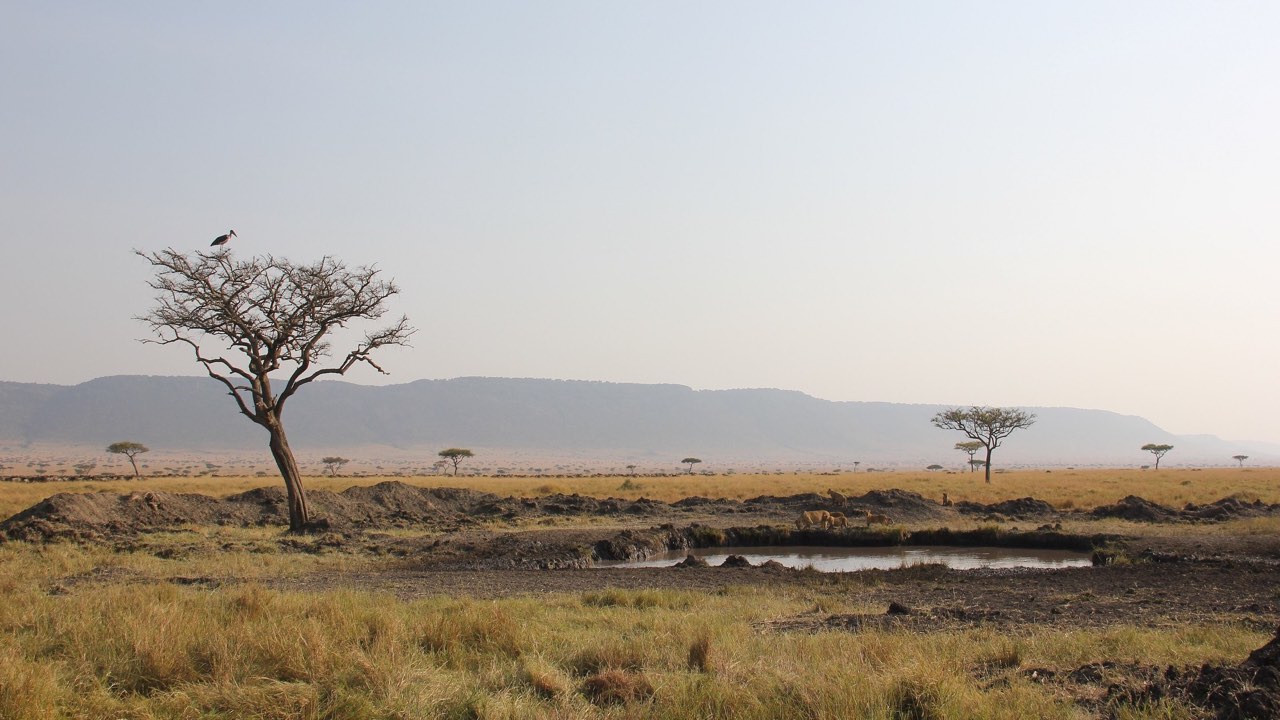
KaribuThe reserve at the heart of Masai Mara, Kenya
Masai Mara National Reserve: who runs which part
The Masai Mara National Reserve, officially the Maasai Mara National Reserve, is the protected core of Masai Mara, Kenya, and a national reserve, not a national park. Narok County manages all of it and runs the Narok side, east of the Mara River, itself; the Mara Conservancy runs the Mara Triangle, west of the river, on the county's behalf. One rate card covers both parts: USD 100 per non-resident adult per day from 1 January to 30 June, USD 200 from 1 July to 31 December, valid 6:00 to 18:00 on the day. The conservancies around it are outside the reserve, with their own fees and rules.
Photo: Laika ac / Wikimedia Commons, CC BY-SA 2.0

Some links on this page are affiliate links: the guide earns a commission when you book through them. The partner sets the price; the guide adds no fee.
So the ticket you buy is a day in the reserve, on whichever side you sleep, and the choice that shapes your trip is where you sleep. Inside the reserve or in a camp on its edge, you drive the reserve's roads by its rules. In a conservancy, you get the conservancy's rules too, which can include walks and night drives, and you pay its fee through your camp. The entrance fee page counts the ticket days for your stay; where to stay compares the three kinds of base.
RamaniThe reserve and the land around it
Who runs which part
The Mara River splits the reserve in two. Tap a part to see who runs it, how you get in, what the ticket is, what you may do and where you can sleep. The Masai Mara map shows the camps and roads in more detail.
East of the Mara River
The Narok side
- Who runs it
- Narok County, which has managed the whole reserve since 2013 and runs this part itself, the Narok Sector.
- How you enter
- By road through Sekenani, Talek, Musiara, Oloolaimutia, Sand River or Enoompuai (new) gates; by air at Keekorok, Olkiombo or Musiara (Governors) airstrips.
- Ticket
- USD 200 per person, non-resident adult, 1 July to 31 December (Narok County 2025/26 schedule); valid 6:00 to 18:00 on the day. Sold by Narok County; the portal takes cash in USD or KES, and card.
- Allowed
- Game drives within the ticket's hours, off-road only where the zone rules allow. Night game drives are prohibited and walking safaris prohibited.
- Where you sleep
- Lodges and tented camps inside: 31 across the whole reserve in the May 2016 audit.
West of the Mara River
The Mara Triangle
- Who runs it
- The Mara Conservancy, a not-for-profit company, since 12 June 2001, on Narok County's behalf. Area: 510 km² (197 sq mi), about one third of the reserve.
- How you enter
- By road through Oloololo Gate or Purungat Bridge Gate, where fees are paid; Little Governors', Angama and Kilo Two are barriers. By air at Mara Serena Airstrip.
- Ticket
- USD 200 per person per day, non-resident adult, 1 July to 31 December (Mara Conservancy rates, listed 12 November 2026); valid 6:00 to 18:00 on the day. Sold by the Mara Conservancy, cashless: M-Pesa or credit card.
- Allowed
- The reserve's rules: night game drives and walking safaris are banned in the Triangle too.
- Where you sleep
- Inside, only Mara Serena Safari Lodge and Little Governors' Camp. Fifteen camps outside send their guests in.
Around the reserve, outside it
The conservancies
- Who runs it
- Each conservancy for its landowners, with the camps as tourism partners. Their association counts 25 conservancies over 180,000 hectares.
- How you enter
- Through your camp. Mara Naboisho Conservancy admits only guests of its partner camps and allows no day trips.
- Ticket
- A conservancy fee, collected by the camp when you book. Enonkishu publishes USD 150 per non-resident adult, without saying per day or per night.
- Allowed
- Set by each conservancy: Naboisho lists guided walks, fly camping and night game drives; Mara North allows night drives in designated areas, back in camp by 22:00.
- Where you sleep
- In the conservancy's member camps: staying in one is how you get in.
| Topic | Narok side | Mara Triangle | Conservancies |
|---|---|---|---|
| Part of the reserve | Yes, east of the river | Yes, west of the river | No, around it |
| Run by | Narok County | Mara Conservancy, for Narok County | Each conservancy |
| Day ticket, non-resident adult | USD 100 / USD 200 | USD 100 / USD 200 | Conservancy fee, through your camp |
| Pay with | Cash in USD or KES, or card | M-Pesa or card, no cash | On your camp bill |
| Night drives, walks | Banned | Banned | Where the conservancy allows them |
| Day visitors | Yes, with a ticket | Yes, with a ticket | Some none: Naboisho admits only its camps' guests |
Fees: January to June / July to December. Narok County's figures are its 2025/26 schedule, the Mara Conservancy's its listed 12 November 2026 rates.
MalipoThe park ticket
What one ticket buys
USD 100Non-resident adult, 1 January to 30 June
USD 200Non-resident adult, 1 July to 31 December
USD 50Child 9 to 17, both seasons
The fee is per person per day, and the day is fixed: the Mara Conservancy's ticket portal says a ticket is valid 6:00 to 18:00 and expires at 18:00 whatever time you buy it. The rate card, co-branded by the Mara Conservancy and Narok County, charges the same fee whether you sleep inside or outside the park (rate card). Overnight guests check out by 10:00, and a game drive on the morning you leave needs a fresh full-day ticket. That is the whole of the 12-hour rule; the ticket-day calculator counts it for your dates.
Which side sells you the ticket follows where you stay. The Mara Conservancy says a Mara Triangle guest who drives in through Sekenani Gate pays nothing there and pays on entering the Triangle at Purungat Bridge (conservation fees). The Triangle is cashless, card or M-Pesa; the Narok side takes cash in USD or KES, and card. Camps and tour operators usually buy the tickets for you and put them on the bill.
A day visit works on the same ticket. A one-day trip from Nairobi, such as GetYourGuide's day trip to the reserve with a Maasai village visit, is listed from USD 190 per person (listed 12 November 2026, park fees excluded in the listing's words), so add one day's fee. The drive is about 5 to 6 hours by road each way, as Mara North Conservancy puts it, which leaves little of the ticket's day for the plains.


How the Mara Conservancy splits Triangle tickets, campsite bookings, balloon fees and annual vehicle fees, as it states it (distribution of fees). Conservancy fees are separate: the camps collect them when you book, and Enonkishu publishes USD 150 per non-resident adult, without saying per day or per night (fee page).

Photo: Laika ac / Wikimedia Commons, CC BY-SA 2.0

Mto MaraThe Mara River
West of this river is the Mara Triangle; east of it, the Narok side.
LangoWays into the reserve
Gates, bridges and airstrips
The reserve's management plan lists the public road entry points as Sekenani, Talek, Musiara, Oloolaimutia, Sand River, Enoompuai (new) and Oloololo; Angama, Mara Engai and Osero Sopia are for camp guests only (management plan). Its air entry points are the Keekorok, Olkiombo, Musiara (Governors), Mara Serena and Kichwa Tembo airstrips; scheduled flights from Nairobi are on the flights page.
Into the Mara Triangle, the Mara Conservancy names Oloololo Gate and Purungat Bridge Gate, where fees are paid, plus the Little Governors', Angama and Kilo Two barriers, and Mara Serena Airstrip. It names three road routes in: via Sekenani Gate on the tarmac from Narok, the fastest for Mara Serena guests; via Aitong through Mara North Conservancy to Oloololo Gate, the fastest for camps just outside the Triangle such as Angama, Kichwa Tembo and Bateleur; and from Kisii via Kilgoris down the Siria escarpment (driving to the Triangle). Inside, Oloololo Gate to Purungat Bridge Gate is a little over 1 hour by road at 50 km/h on the Triangle main road.
The two sides meet at the Mara Bridge, which Narok County repaired after the 2024 rains and commissioned in July 2024 (county notice). To the south, the Kenya Revenue Authority lists the Sand River gate on the Mara-Serengeti border as a closed point of entry and exit (points of entry), so the Serengeti in Tanzania is not a road onward from here; the Masai Mara and the Serengeti compares the two. The road from the capital is on Nairobi to Masai Mara, and where the Masai Mara is puts it on the map of Kenya.


- 6:00Mara Triangle gates open
- 18:30No entry after this, either side
- 19:00Out of the reserve, or back at your camp or lodge
Gate hours: the reserve's management plan and the Mara Triangle's park rules.
SheriaRules inside the reserve
What the rules allow, and where
Narok County's management plan for 2023 to 2032 sets the visitor rules for the whole reserve, the Narok side and the Mara Triangle; the Mara Conservancy's own park rules add to them in the Triangle. The conservancies outside set their own.
-
Banned
After dark
Night game drives are prohibited throughout the reserve, on both sides of the river. You are back in camp or out of the gates by 19:00.
-
Banned
On foot
Walking, horseback and bicycle safaris are prohibited in the reserve. You may leave the vehicle only at picnic spots or other designated places, and stay within 10 m (33 ft) of it.
-
5
At a sighting
The most vehicles allowed around lions, rhinos, leopards and cheetahs; the rest wait at least 100 m (328 ft) away, and you move on after 15 minutes when others are waiting. The Mara Conservancy's own park rules set 10 minutes in the Triangle when more than five vehicles wait (Mara Triangle).
-
Zoned
Off the road
Never in the High Use Zone or the Mara River zone. In the Low Use Zone only to approach big cats, with at most 5 vehicles, at least 25 m (82 ft) from the cats and at most 15 minutes when others wait.
-
50 / 30 km/h
Speed
The first on graded roads, the second on all other roads, on both sides of the river.
-
Keep clear
River crossings
No parking that blocks the herds' path, no driving through them, no getting out at or near the crossing points. The plan records more than 150 vehicles at a single crossing; see the migration page for the herds.

The conservancies run their own rule books for their own guests. Mara North Conservancy allows night game drives only in designated areas, with red filters on the spotlights, and vehicles back in camp by 22:00 (game drive etiquette). Mara Naboisho Conservancy lists guided walking, bush meals, fly camping and night game drives among its activities. The conservancies page sets them side by side.
Crowding is part of why the rules exist. The plan puts the reserve's carrying capacity at about 1 to 1.2 visitors per km², which it says is about the high-season density in the Mara Triangle; for the central Narok side it gives 2 to 2.5 visitors per km² in high season. For safety advice, see is the Masai Mara safe.
The reserve's zones, by side
| Zone | Narok side | Mara Triangle |
|---|---|---|
| High Use (no off-road driving) | just over 638 km² (246 sq mi) | about 198 km² (76 sq mi) |
| Low Use (off-road to approach big cats only) | 374 km² (144 sq mi) | 203 km² (78 sq mi) |
| Mara River zone, 1.5 km (0.9 mi) either side | just over 62 km² (24 sq mi) | just under 77 km² (30 sq mi) |
Around the boundary the plan draws a buffer zone of 2 km (1.2 mi), outside the reserve.

Photo: Sumeet Moghe / Wikimedia Commons, CC BY-SA 4.0

ChuiLeopard
Leopards are one of the four animals the five-vehicle rule names.
KambiWhere you can sleep
Beds inside, beds outside
31Lodges and tented camps inside the reserve, May 2016 audit
2Places to stay inside the Mara Triangle
The audit of May 2016 cited in the management plan counted 1,382 beds in those lodges and camps, and the plan allows no new accommodation and no added beds anywhere in the reserve. Most visitors sleep outside: camps in the buffer zone around the reserve take around 60 percent of them, and drive in on a day ticket.
In the Mara Triangle the only two are Mara Serena Safari Lodge and Little Governors' Camp, and the Mara Conservancy owns no camp and takes no bookings (camps and lodges). It lists 15 camps and lodges outside the Triangle whose guests use it and pay its fee, among them Angama Mara Lodge, Kichwa Tembo Camp, Bateleur Camp and Mara West.
In a conservancy you sleep in one of its camps, and some admit nobody else: you cannot stay in or visit Mara Naboisho Conservancy without staying at a partner camp, and it allows no day trips (Naboisho). The camps and lodges and hotels pages list the places; where to stay in the Masai Mara weighs inside against outside.
HifadhiA protected area since 1948
How the reserve took its shape
- 1948First set aside as a 520 km² (201 sq mi) game reserve in what is now the Mara Triangle.
- 1961Extended to 1,831 km².
- 1974Established as a game reserve by Legal Notice 271 of 1974, within Boundary Plan 216/50 of the Survey of Kenya.
- 1984Reduced to its present boundary.
- 1994Management split between the Narok and Trans Mara county councils (Mara Conservancy; the reserve's management plan gives 1995).
- 2001The Mara Conservancy takes over the Mara Triangle on 12 June.
- 2013Narok County takes over the whole reserve; the conservancies form their association.
- 2016A ten-year agreement between Narok County and the Mara Conservancy.
- 2023Kenya puts the reserve on its UNESCO tentative list, with its two management sectors.
1,510 km²The reserve, Government of Kenya (UNESCO tentative-list entry 2023)
510 km²The Mara Triangle, Mara Conservancy
Kenya's UNESCO tentative-list entry puts the reserve at 1,510 km² (583 sq mi). It is bounded by the Serengeti to the south, the Siria (Oloololo) escarpment to the west and Maasai pastoral ranches to the north, east and west; the Serengeti is in Tanzania. Its main rivers are the Sand, the Talek and the Mara. The Triangle is the wedge between the Oloololo Escarpment, the Mara River and the Kenya-Tanzania boundary (Mara Conservancy); more on it on the Mara Triangle page.
People often search for it as Masai Mara National Park, but it is a national reserve. Around it, the Maasai Mara Wildlife Conservancies Association counts 25 conservancies spanning over 180,000 hectares. The Maasai communities who live around the reserve have their own page: the Maasai people.


WanyamaAnimals, as counted
Elephants, rhinos and birds by the count
2,595Elephants in the Mara ecosystem, aerial census 2021
more than 470Bird species recorded in the reserve, Mara Conservancy
The Kenya Wildlife Research and Training Institute's aerial census of 2021 counted 668 elephants in the main reserve block, 816 in the Mara Triangle and 2,595 across the whole ecosystem (published in the Mara Conservancy's June 2023 report).
All of the big five live here, the rarest being the black rhino: the Mara Conservancy puts the Triangle's resident black rhinos at upwards of ten and the whole Masai Mara's at between 25 and 30, and says the reserve holds the only indigenous black rhino population in Kenya unaffected by translocations (black rhino page). Its bird list runs to more than 470 species. Which animals turn up where is on Masai Mara animals.

Photo: Laika ac / Wikimedia Commons, CC BY-SA 2.0

WanyamaTopi, Mara Triangle
Topi keep watch from the old termite mounds of the Triangle's plains.
ZiaraTours into the reserve
Tours that include the reserve
Both safaris below spend their game drive days in the reserve and leave the park ticket out of the price, so add it yourself: for three days and two nights it comes to USD 200 to 300 per adult from January to June, or USD 400 to 600 from July to December. The safari page compares the kinds of trip, and safari cost adds up a whole stay.
-
GetYourGuide · park fees excluded
Three-day, two-night group safari in a 4WD jeep
from USD 199 per person, listed 12 November 2026
Three days, two nights in a group. The listing puts the government park entrance fees among its exclusions.
-
Viator · park fees excluded
Three-day guided safari from Nairobi
from USD 195 per person, listed 12 November 2026
For two adults with no date picked; the price varies by group size. "Government Fees" sit under the exclusions, and a separate option includes them.
MaswaliAbout the reserve
Questions about the reserve
The rules in full: Narok County's reserve management plan 2023 to 2032. The Triangle's history: the Mara Conservancy. All Masai Mara pages.
Is the Masai Mara a national park?
No. There is no Masai Mara National Park: the place is the Maasai Mara National Reserve, a national reserve. Narok County manages the whole reserve, and the Mara Conservancy runs the Mara Triangle, west of the Mara River, on the county's behalf. Its fees, gates and rules are the county's and the Conservancy's.
Can I pay the park fee in cash?
On the Narok side, yes: the Narok side takes cash in USD or KES, and card. In the Mara Triangle, no: it takes card or M-Pesa only. Which side sells you the ticket follows where you sleep, and most camps and tour operators buy the tickets for you and put them on the bill. A ticket is valid 6:00 to 18:00 on its day; the entrance fee page counts the days.
Can new lodges be built inside the reserve?
No. The management plan allows no new accommodation and no added beds anywhere in the reserve. The audit of May 2016 it cites counted 31 lodges and tented camps inside with 1,382 beds, and in the Mara Triangle only two places to sleep stand. Most visitors sleep in camps outside the reserve and drive in on a day ticket.
How much does it cost to visit the Masai Mara National Reserve?
The park fee for a non-resident adult is USD 100 per person per day from 1 January to 30 June and USD 200 from 1 July to 31 December, on either side of the river; children 9 to 17 pay USD 50. Lodging, transport and any conservancy fee come on top.
Who manages the Mara Triangle?
The Mara Conservancy, a not-for-profit company, since 12 June 2001, on behalf of Narok County; their current agreement dates from 2016. It sells the Triangle's tickets, cashless only, and says it keeps 36% of the fee revenue, with 55% going to Narok County.
Can you do walking safaris or night drives in the Masai Mara?
Not in the reserve: night game drives and walking, horseback and bicycle safaris are banned on the Narok side and in the Mara Triangle. Some conservancies outside the reserve offer them to their own camp guests, among them Mara Naboisho (walks, night drives) and Mara North (night drives in designated areas).
Sources
- GetYourGuide listing '3-Day, 2-Night Maasai Mara Group Safari in a 4WD Jeep' (operator Perfect Wilderness Tours and Safari), read 12 November 2026: listed price from USD 199 per person, 3 days and 2 nights, group of 7-8 (private option available), park fees excluded. GetYourGuide: 3-Day, 2-Night Maasai Mara Group Safari in a 4WD Jeep, 2026-11-12.
- GetYourGuide listing 'Nairobi: Day Trip to Maasai Mara Reserve & Maasai village' (operator Niroskos Tours And Safaris), read 12 November 2026: listed price from USD 190 per person, 1 day, small group, park fees excluded. GetYourGuide: Nairobi: Day Trip to Maasai Mara Reserve & Maasai village, 2026-11-12.
- Viator listing '3 Days Maasai Mara Guided Safari from Nairobi' (operator not shown on the page), read 12 November 2026: listed 'from' price USD 195 per person on the search page for 2 adults with no date picked (the page says the price varies by group size), 3 days and 2 nights, group (not stated), park fees excluded ('Government Fees' under exclusions; a separate option includes them). Viator: 3 Days Maasai Mara Guided Safari from Nairobi, 2026-11-12.
- The Mara Conservancy / KAPS ticket rate card, co-branded with Narok County Government, charges a non-resident adult the same park fee whether accommodated inside or outside the park: USD 200 per person per day from July to December. Mara Conservancy / KAPS: Park Fees Itemization rate card (Nature Paas ticket portal).
- The same co-branded rate card charges a non-resident adult USD 100 per person per day from January to June, whether accommodated inside or outside the park; non-resident children aged 9 to 17 and students in organized groups pay USD 50 per person per day in both blocks. Mara Conservancy / KAPS: Park Fees Itemization rate card (Nature Paas ticket portal).
- Narok County's 2025/26 Park Fees & Charges schedule charges a non-resident adult a Maasai Mara National Reserve entry fee of USD 100 per person in the low season ('January - June'); the schedule gives months only and no validity period (the day boundaries 1 January to 30 June are in the Finance Act 2023, NRK-SEA-001; the 6:00 to 18:00 validity in NRK-TKT-001). Narok County / Maasai Mara National Reserve: 2025/26 Park Fees & Charges (PDF), 2025-02-26.
- Narok County's 2025/26 Park Fees & Charges schedule charges a non-resident adult a Maasai Mara National Reserve entry fee of USD 200 per person in the high season ('July - December'); the schedule gives months only and no validity period (the day boundaries 1 July to 31 December are in the Finance Act 2023, NRK-SEA-001; the 6:00 to 18:00 validity in NRK-TKT-001). Narok County / Maasai Mara National Reserve: 2025/26 Park Fees & Charges (PDF), 2025-02-26.
- The Maasai Mara National Reserve Management Plan 2023-2032 bans night game drives throughout the reserve (Narok side and Mara Triangle). Narok County: Maasai Mara National Reserve Management Plan 2023-2032 (Final, February 2023).
- The Maasai Mara National Reserve Management Plan 2023-2032 bans walking, horseback and bicycle safaris in the reserve. Narok County: Maasai Mara National Reserve Management Plan 2023-2032 (Final, February 2023).
- The reserve management plan visitor rules allow at most five vehicles around lions, rhinos, leopards and cheetahs; others must wait at least 100 meters away and vehicles must move on after 15 minutes when others are waiting. Narok County: Maasai Mara National Reserve Management Plan 2023-2032 (Final, February 2023).
- The reserve management plan visitor rules set a maximum speed of 50 km/h on graded roads and 30 km/h on all other roads in the Maasai Mara National Reserve. Narok County: Maasai Mara National Reserve Management Plan 2023-2032 (Final, February 2023).
- The Mara Conservancy charges a non-resident adult a Mara Triangle conservation (park entry) fee of USD 100 per person per day from 1 January to 30 June; the table heading for non-residents says it applies whether accommodated inside or outside the park. Mara Conservancy: Conservation Fees page (fee tables as images named *-2024).
- The Mara Conservancy charges a non-resident adult a Mara Triangle conservation (park entry) fee of USD 200 per person per day from 1 July to 31 December; the table heading for non-residents says it applies whether accommodated inside or outside the park. Mara Conservancy: Conservation Fees page (fee tables as images named *-2024).
- Mara Serena Safari Lodge and Little Governors' Camp are the only accommodations inside the Mara Triangle; the Conservancy owns no camp and does not take bookings. Mara Conservancy: Camps & Lodges.
- Park, camping, vehicle and balloon fees. Narok County 2025/26 Park Fees & Charges and Narok County Finance Act 2023 (reserve, Narok side); Mara Conservancy conservation fees (Mara Triangle); Kenya Wildlife Service Conservation Fees 2025 (Nairobi, Amboseli, Lake Nakuru); Enonkishu Conservancy fee page
- Travel times and distances. Drive times as stated by Mara North Conservancy, Mara Siana Conservancy, the Mara Conservancy, Safarilink and AirKenya; road distances from KeNHA, Narok County, Kenya Wildlife Service and Mara Siana Conservancy; flight times from the 2026 timetables of Safarilink, AirKenya, Governors' Aviation and Mombasa Air Safari
- Unit conversions. Metric figures with US equivalents (1 km = 0.621371 mi, 1 m = 3.28084 ft, 1 kg = 2.20462 lb, 1 ft = 0.3048 m, 1 acre = 0.404686 ha, °F = °C × 9/5 + 32)
- Figures where sources differ. One register row per figure where official sources conflict (data/canon.json names the row, the body and the reason)
- Masai Mara park fees. Mara Conservancy and Narok County Government rate card, non-resident adult per day; ticket valid 6:00 to 18:00